Author:Date:2015-10-30
LED THERMAL PCB:
MHE301 is by far the more superior thermal substrate solution than conventional MCPCB in terms of both material and structural designs. It specifically answers the need for HB and ultra HB LEDs as it drains heat with metallic MHE (“Micro Heat Exchanger”) at the rate of up to 400 W/mK. MHE301 exhibits a thermal impedance of 0.025 C cm2/Watt at its best making it arguably the best commercially available solution for control of the LED junction temperature.
Comparing MHE to conventional MCPCB solutions
Exhibit 1:
MHE301 is composed of 3 structural parts: copper layer micro heat exchanger MHE - heat dissipation
copper base.
a.Upper copper layer as circuit layer;
b.MHE provides optimal thermal path for mounted LED, transferring heat to the base layer;
c.Base copper layer dissipates heat further to the ambient or heat sink that completes the thermal
path to the surroundings.
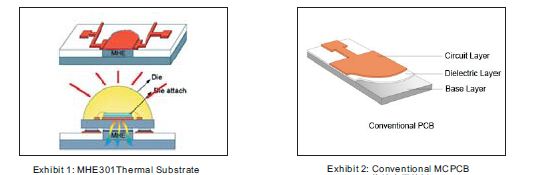
Exhibit 2:
Conventional MCPCB is composed of 3 parts: circuit layer dielectric layer base layer, mostly aluminum.
a.Upper copper layer as circuit layer;
b.Dielectric layer with varying thermal conductivities ranging from 1.3 to 2.2 W/mK (certain brands claim to achieve up to 7 or 8 W/mK). Key components consist of polymeric materials and conductive fillers.
c.Base layer mostly aluminum transfer heat further to the surroundings.
Conventional MCPCB offers conductivity 4 to 8 times higher than FR-4 of comparable thickness, which is a better solution for low- to medium-power LED, for example 1W single chip applications. However, in comparison, MHE is at least some 2 or even 3 orders of magnitude MORE conductive as copper offers.
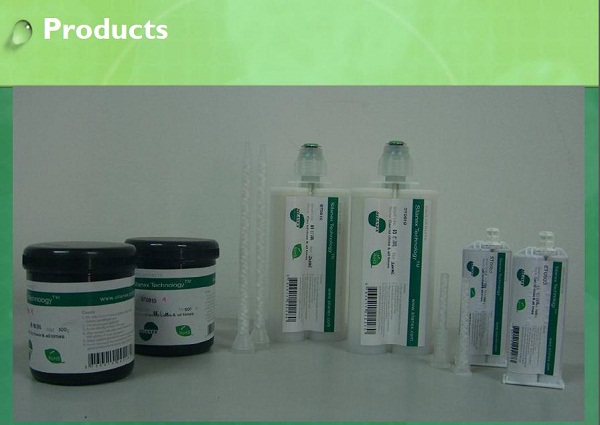
Silanex Technology
ST0903 Twin componets – normal temperature curing, 30w/m.k